
The Role of Golf Courses in Urban Greenspace Access
With nearly 80 percent of the U.S. population residing in urban areas, greenspaces such as public parks, recreational areas, nature preserves, and community gardens often serve as the primary or only places where city residents can regularly experience nature, recreation, and outdoor social life. It is now widely understood that time spent in greenspaces, and in nature more broadly, plays an important role in supporting both physical and mental well-being. Documented benefits include reduced stress, lower blood pressure, improved cognitive function, and better overall cardiovascular health. Beyond individual health benefits, urban greenspaces provide important community-wide benefits, including reducing urban heat island effect, filtering and slowing stormwater runoff, and improving air quality.
Despite these critical benefits, tens of millions of Americans living in urban areas lack sufficient access to publicly available greenspace. In many cities, expanding greenspace is constrained by limited land availability, high land costs, and intense competition from other urban priorities such as housing and commercial development. Most efforts to improve greenspace access and equity center around converting underutilized urban areas such as vacant lots and brownfields into public parks. But what about large green landscapes that are already there?
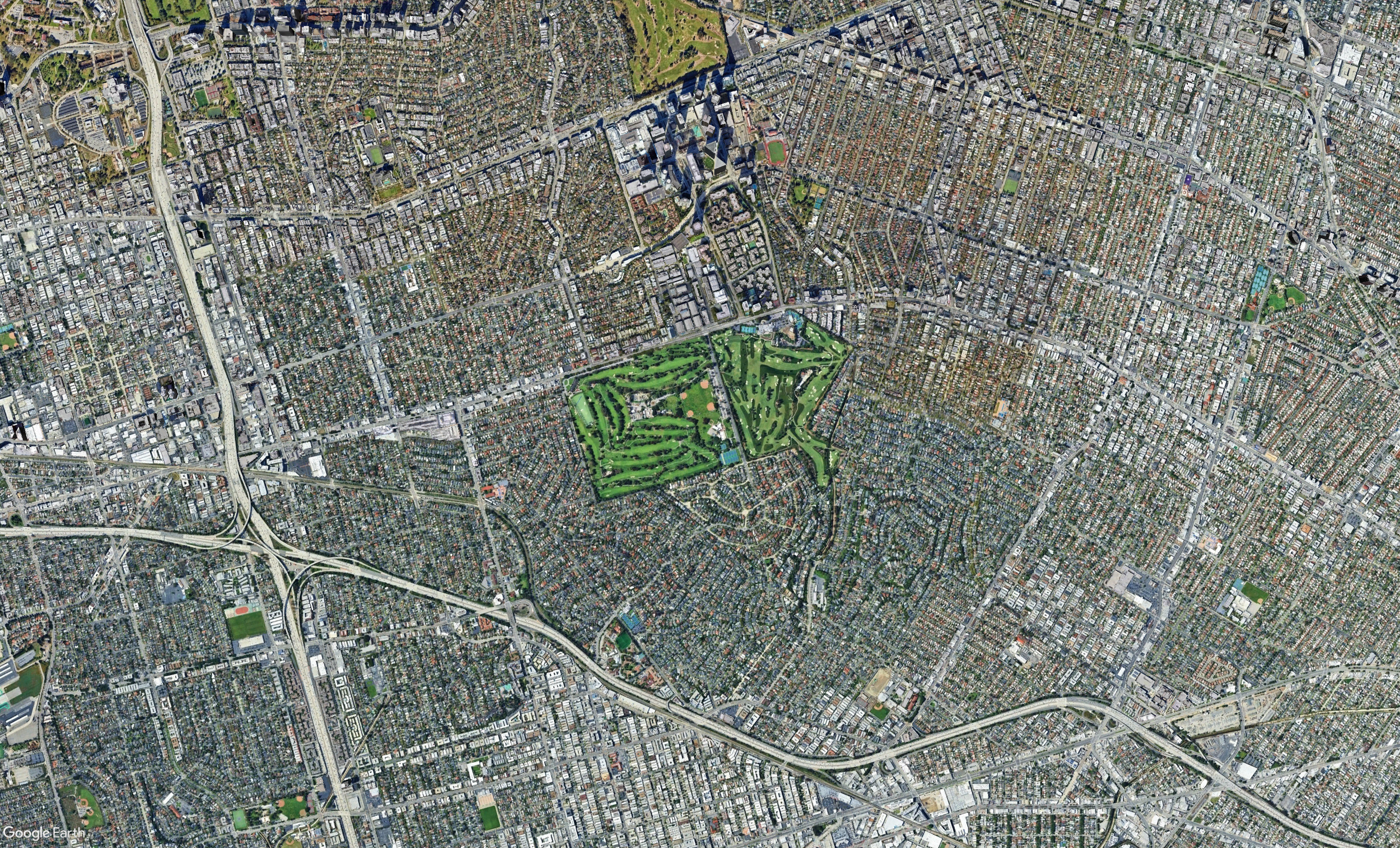
In cities across the country, expansive and continuous green spaces exist that are often overlooked in broader conversations about urban greenspace: golf courses. When viewed from above, golf courses stand out immediately. Set within dense grids of housing, roads, commercial development, and industrial zones, they appear as uninterrupted patches of green, frequently rivaling or even exceeding the size of nearby public parks.
This begs an important question: what role do urban golf courses play in shaping access to greenspace in American cities? Exploring this question requires understanding the scale of urban golf courses and the share of total greenspace they represent in cities, who lives near these landscapes and is able to use them, and what “access” truly means when evaluating greenspace in urban environments.
What does access actually mean? When discussing access to greenspace, it is easy to equate access with proximity. But access is far more nuanced than distance alone. A greenspace can be nearby and still be effectively out of reach for many people. In the context of urban greenspace, access refers to a person’s ability to realistically use a space when and how they need it. This includes physical proximity, as well as a space’s capacity to accommodate users, its affordability, the convenience of its hours, and whether people feel welcome and comfortable there. In other words, access is not just about whether a space exists, but whether it functions as a usable resource for the surrounding community.
These distinctions are especially important when evaluating golf courses. While many urban golf courses are physically close to residential neighborhoods, factors such as costs (green-fees, memberships, and equipment), limited tee-time availability, and social perceptions of exclusivity can all shape whether nearby residents are actually able or likely to engage with these landscapes. Without considering these dimensions of access, assessments of greenspace access risk overstating how well cities are serving their residents.
Understanding access as a layered concept helps explain why some green spaces, despite their size and visibility, do not deliver the same benefits as publicly accessible parks. It also provides a more accurate framework for evaluating the role golf courses play within the broader urban greenspace network.
A 2023 study by J. C. Ryan examined the scale and location of urban golf courses and their implications for greenspace access across cities in the United States. The analysis identified 6,962 golf courses located within urban areas, collectively covering approximately 3,102 km² of urban land. This equates to roughly 29% of all urban greenspace, meaning that nearly one-third of the greenspace in U.S. cities are golf courses. From a spatial perspective alone, golf courses represent one of the most significant forms of urban greenspace in the country.
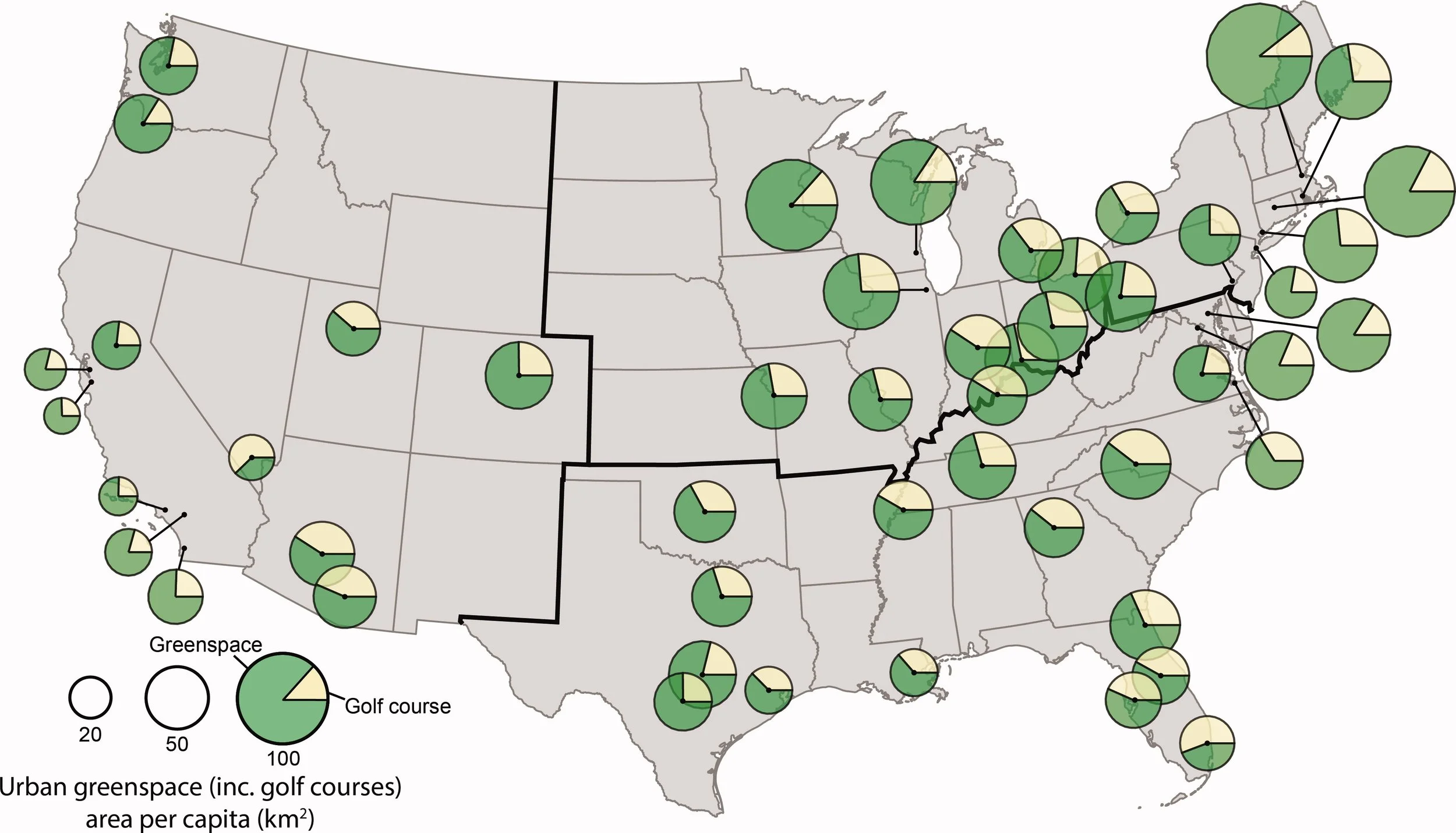
Map showing area of urban greenspace per capita for the fifty largest cities in the United States by population. The size of the circles represents the greenspace area per capita for all types of greenspace (including golf courses). The green wedges represent the area of publicly accessible greenspace and the yellow wedges represent the area of golf course per capita. Source: Ryan, J. C. (2023).
The study also evaluated how proximity to these landscapes shapes access. Using a 1 km threshold, roughly a 10–12 minute walk and a distance commonly used in greenspace access research, Ryan found that 3.4% of the U.S. urban population, or nearly six million people, live within walking distance of a golf course but more than 1 km from any publicly accessible greenspace. For these residents, golf courses are the closest green landscapes in their daily environment. When examining the demographics of these populations, the study found that neighborhoods most dependent on golf courses for nearby greenspace tend to be wealthier and have a higher proportion of White residents than the U.S. urban average.
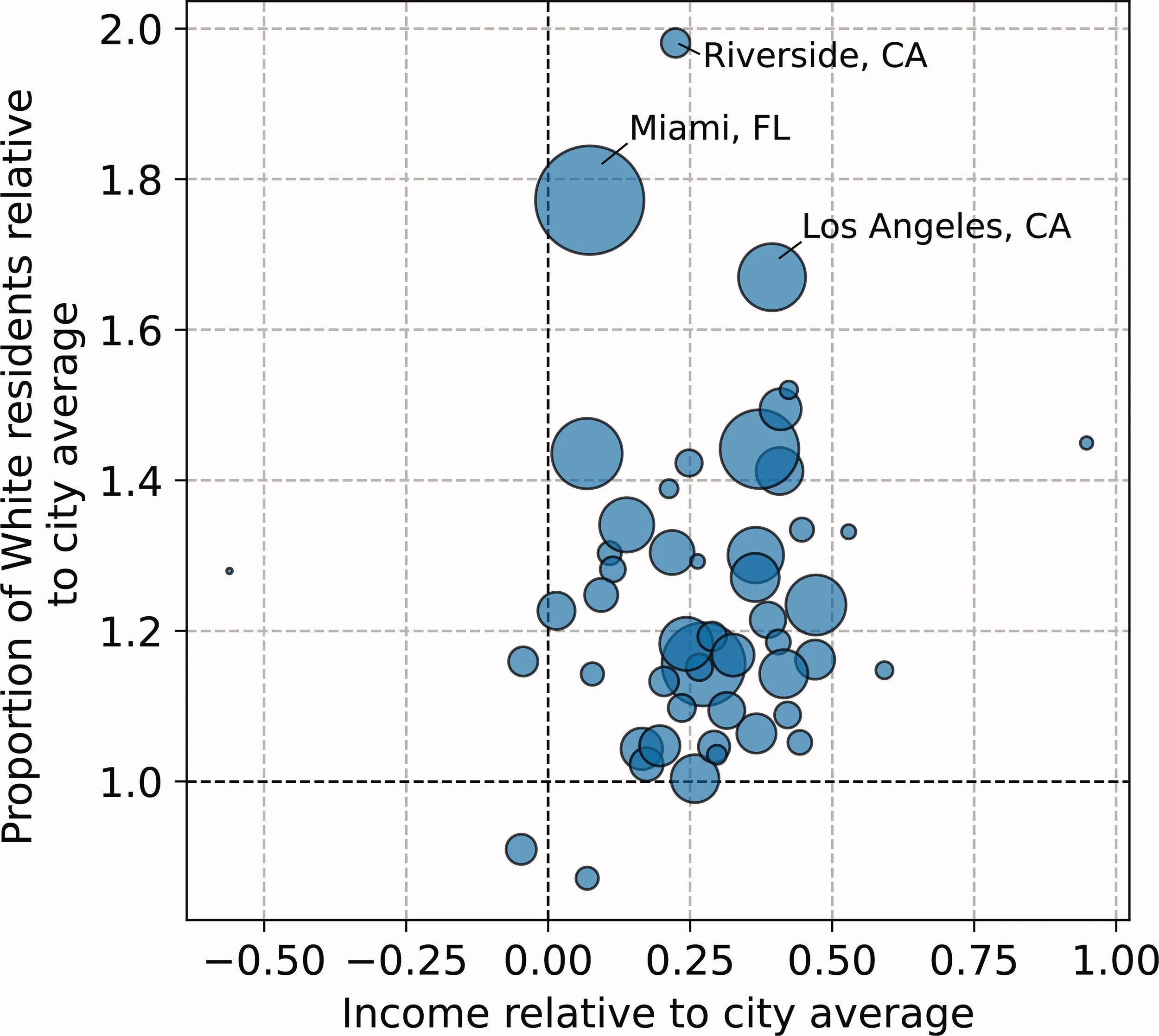
Characteristics of people who live within 1 km of a golf course, but further than 1 km from other types of greenspace for the fifty largest cities in the United States by population. The size of the circles represents the number of people. Overall, people who live near golf courses but far from other types of greenspace tend to be wealthier than and more often White the city average. Source: Ryan, J. C. (2023).
Looking at the bigger picture, the findings from the 2023 study by J. C. Ryan highlight the enormous potential for urban golf courses to serve as meaningful green spaces, given their size, abundance, and proximity to city residents. Accounting for nearly one-third of all urban greenspace in the United States, golf courses represent some of the largest and most visible green landscapes embedded within urban environments. However, despite their scale, barriers such as cost, limited access windows, and longstanding perceptions of exclusivity often restrict the extent to which these spaces deliver physical, mental, and social benefits to surrounding communities.
The study suggests that reducing barriers to access urban golf courses could provide immediate greenspace benefits for roughly six million people, particularly those for whom golf courses are the only green landscapes within walking distance of their homes. At the same time, the demographic patterns revealed by the analysis complicate this opportunity. Nationally, communities most likely to live near golf courses tend to be wealthier and more often White than the urban average, meaning that policies focused solely on expanding access to golf courses would be unlikely to address the persistent greenspace shortages experienced by lower-income and predominantly minority neighborhoods. This does not suggest that efforts to increase access to urban golf courses are misguided, but rather that expanding access to golf courses alone is unlikely to resolve broader inequities in greenspace distribution and should be viewed as only one tool within a more diverse set of strategies aimed at improving equitable greenspace access for city residents.
In an increasingly digital world, the importance of spending time outdoors and engaging with others in shared physical spaces has become more apparent. As face-to-face interaction becomes less central to daily life, greenspaces offer places where people can slow down, be present, and reconnect with one another and with nature, especially within highly urbanized environments. At the same time, continued urban growth and suburban expansion make it increasingly difficult to provide new public greenspace where it is needed most. Finding impactful and equitable ways to expand access to nature within existing urban landscapes is therefore critical moving forward. In this context, golf courses represent a unique and often overlooked opportunity.
While golf courses are not a silver bullet for addressing greenspace inequities, the research shows that increasing access to these landscapes could meaningfully benefit millions of urban residents. Efforts such as more affordable fee structures, expanded hours or uses beyond traditional golf, and community-oriented programming can help these spaces function as more inclusive green assets rather than single-purpose facilities.
One of the most compelling examples of a golf course serving as more than just a place to play comes from The Old Course at St. Andrews. Every Sunday, the most historic course in the game closes to golfers and opens to the public, transforming into a shared public park where people walk the course, picnic, and gather, dogs included. Even at the very heart of golf’s tradition, the landscape itself is treated as a communal asset, not solely a sporting venue.
The lesson is not that all golf courses should follow the same model, but that golf landscapes can be more flexible and more integrated into community life than they often are today in the U.S. As cities grapple with how to provide meaningful access to nature to its citizens, reimagining how existing green spaces function may be just as important as creating new ones.
